👋 Provider Intro
Situation Today

Most often, you use an API to create infrastructure in the cloud. More advanced teams have leveraged the benefits of Infrastructure as Code with tools like Terraform. While this already offers massive benefits like reproducibility and version control, there is one thing missing: what happens if your landscape changes after you apply it? It is no longer consistent with the state specified in the configuration file.
Introducing Crossplane
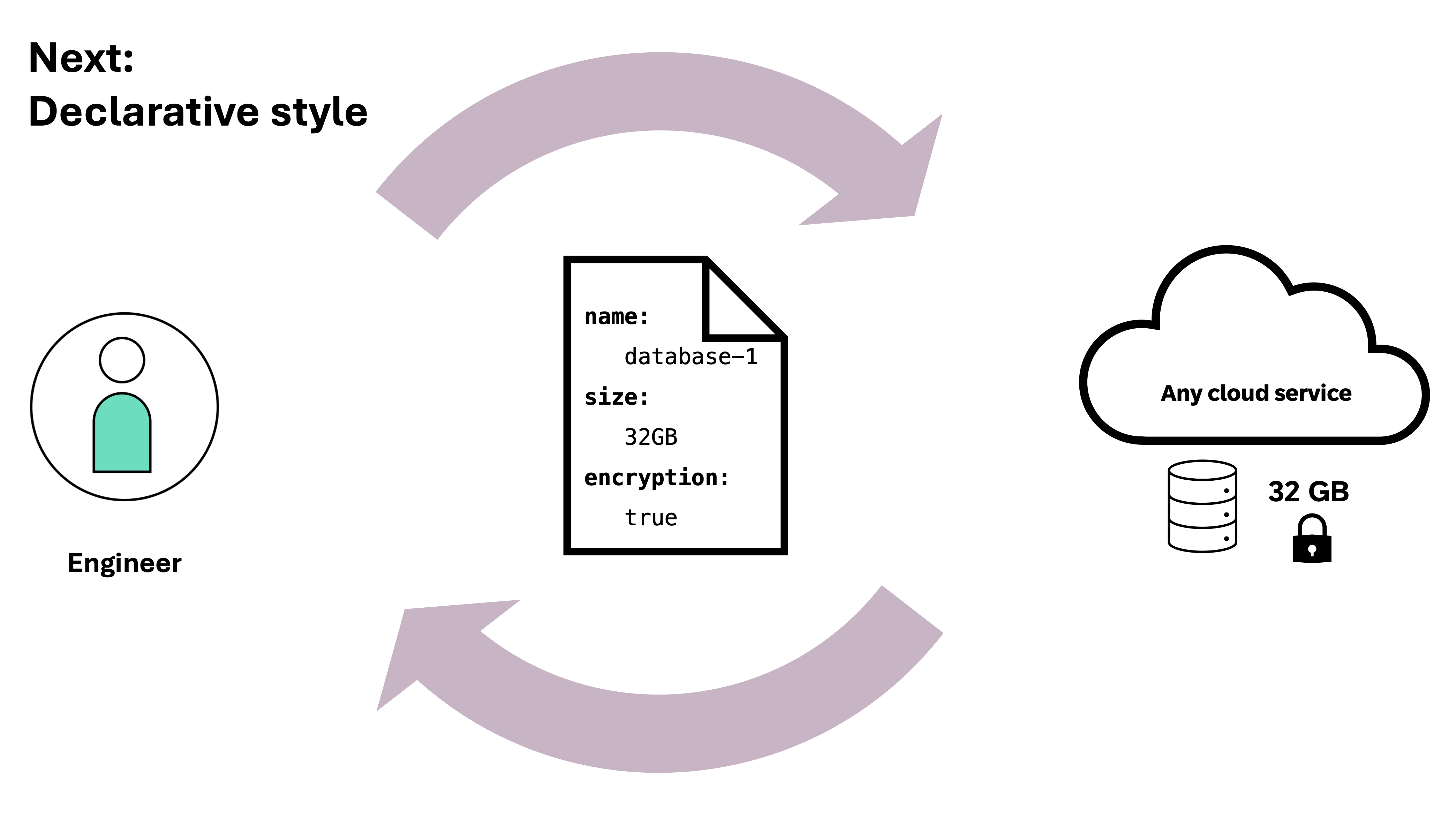
Having faced these challenges, especially in larger organizations, one can quickly see that using Infrastructure as Code alone is not enough. We want clarity about the state of our landscape. When we define Infrastructure as Code, it should truly reflect that definition no matter what. This is what Crossplane does for us. It uses a declarative approach to manage APIs and leverages the Kubernetes reconciliation loop to repeatedly check and ensure that the state defined in our files matches the actual state at the API. This is what we call Infrastructure as Data. We are not using a high-level markup language or dependency trees of related resources. Only Cloud native and Kubernetes like resources, this is the way to the future!
How it works
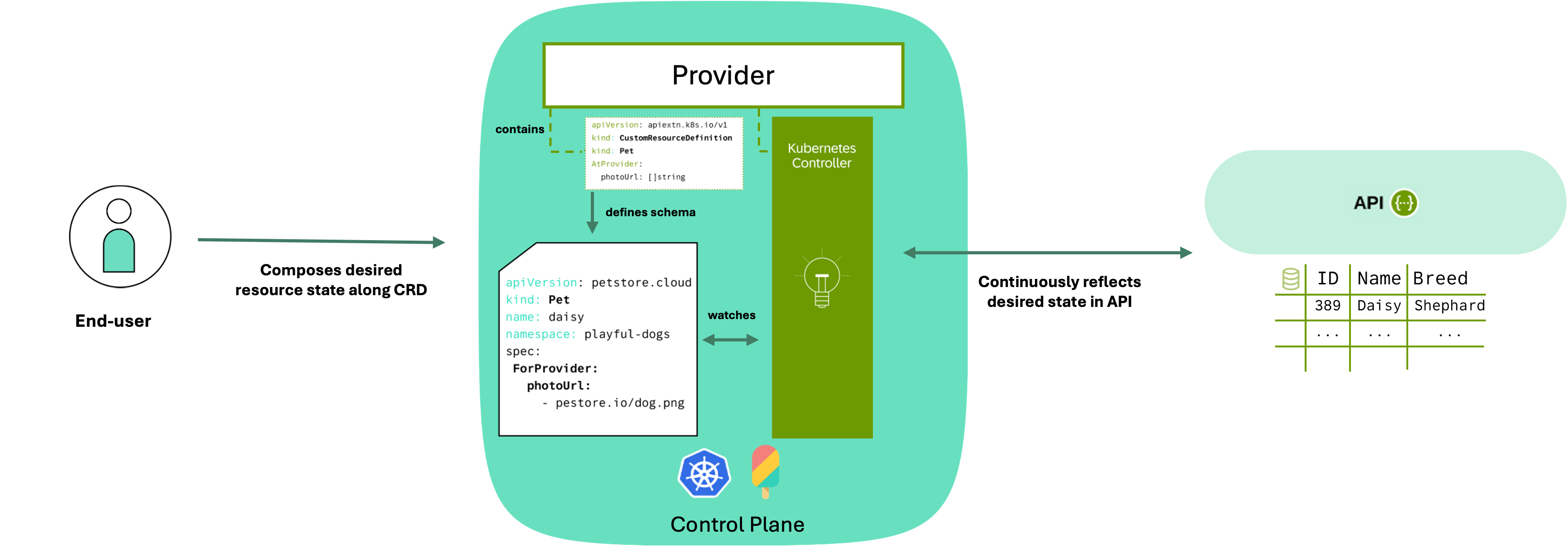
Crossplane uses the concept of Kubernetes Operators to extend Kubernetes with custom behavior. This enables us to introduce Crossplane Providers and custom Managed Resources to a Control Plane.
Control Plane
Since we are now steering and managing external APIs via the cluster, it acts as a cockpit for all our resources. Therefore, the original Kubernetes cluster becomes a Control Plane.
Provider
Using a cockpit without being able to steer is not very useful. Providers bring functionality into the Control Plane. They generally consist of two components: first, they introduce the ability to use custom, API-specific resources on a cluster. Second they use a Kubernetes Controller to translate actions on those newly introduced resources into real API calls.
Managed Resource
Managed Resources describe instances of custom API objects. Each Provider usually offers multiple custom objects to a Control Plane. Managed Resources describe instances of these objects.